
DDD Context Mapper: A single-page Tool for Context Maps
I built a single-page context mapper diagram tool because I was not happy with any tool I am aware of for this purpose. I also wanted the format to be JSON, easily machine readable, so I can export data from other systems and use this tool to visualize it without a proprietary file format or a heavy toolchain in between.
So far I have kept it intentionally simple. There is no need to bloat it into a ~160 MB Electron wrapper or to pull in hundreds of JavaScript dependencies through a build pipeline. The app is one static HTML file that uses D3.js for layout and interaction; you open it in a browser and you are done. That is a deliberate application of the KISS principle: the smallest thing that does the job well.
If you are wondering whether a “full” desktop app would be better: for my own use, the answer is no. I care more about portability, inspectability, and integration (JSON in, diagram out) than about packaging complexity. I might extend the tool based on feedback—but the baseline will stay lean unless there is a strong reason not to.
What it does
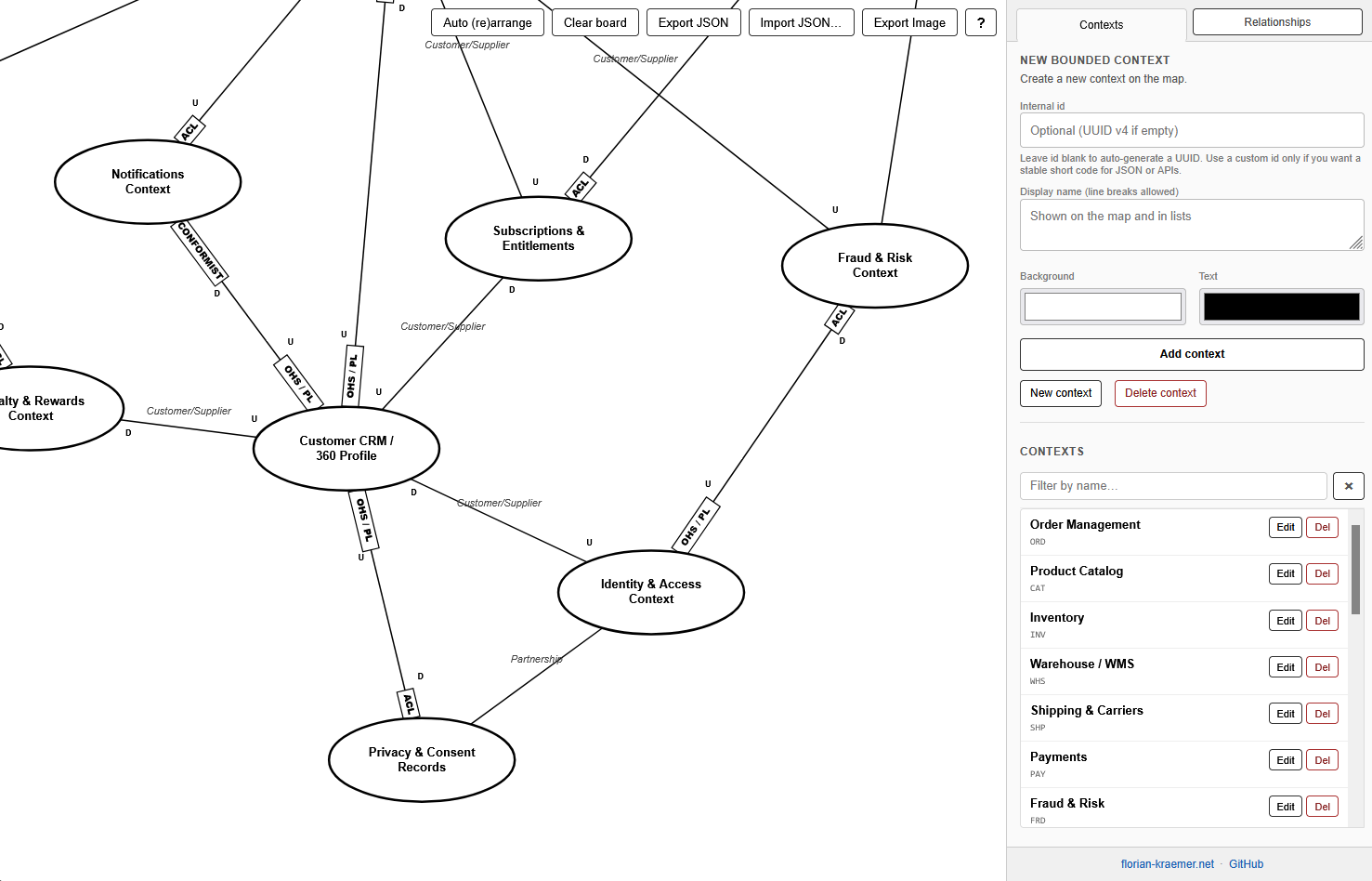
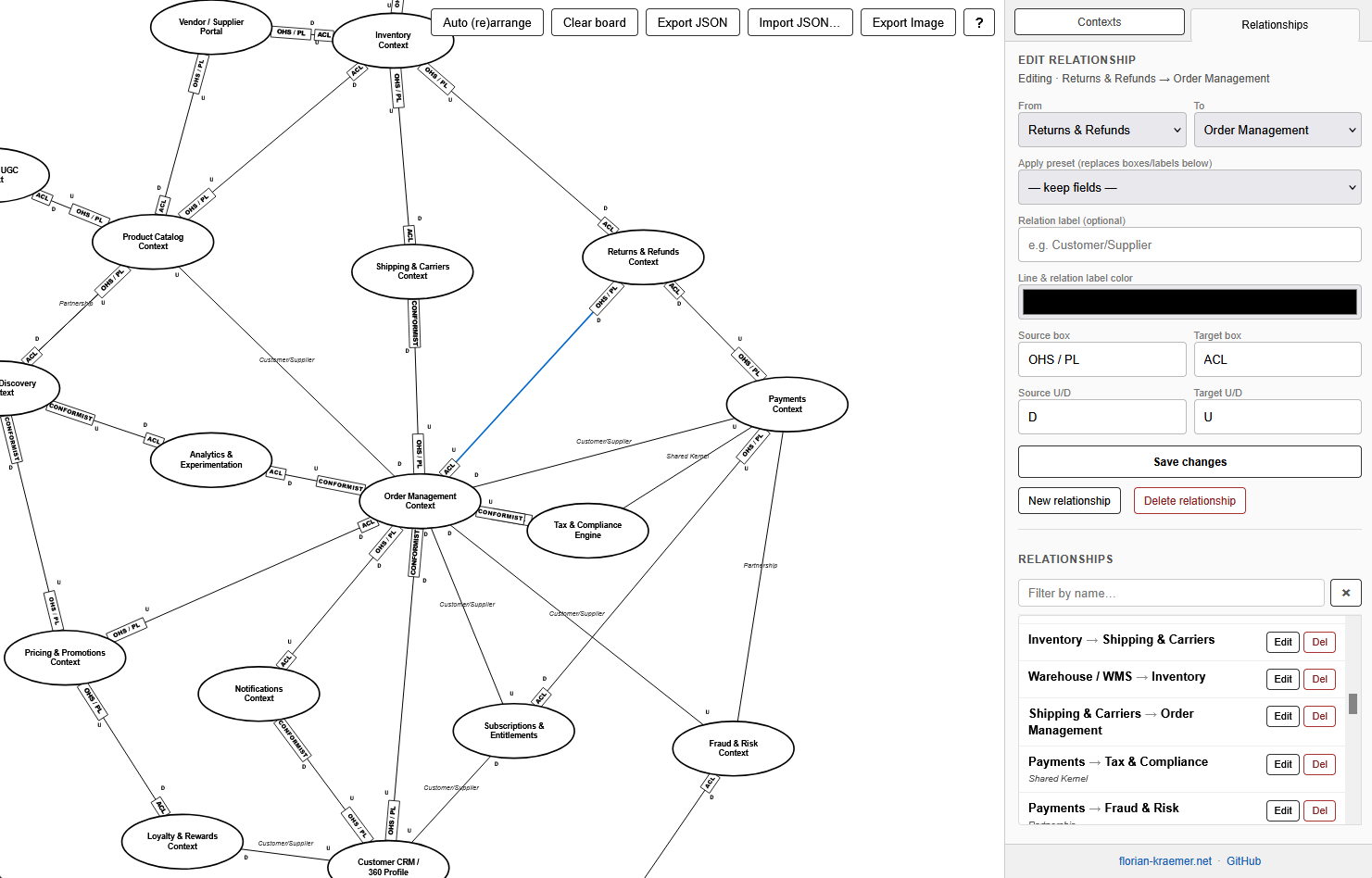
DDD Context Mapper is a browser-based editor for Domain-Driven Design context maps. You place bounded contexts as shapes on a canvas and connect them with directed relationships that can carry familiar DDD-style labels (for example Customer/Supplier, Shared Kernel, Anti-Corruption Layer) and upstream/downstream markers.
Try it
Keep context-mapper.html and context-map.schema.json in the same folder, then open the HTML file in a modern browser. If you want import validation, serve the folder with any static file server; on plain file:// opens, validation may be skipped with a console warning.
Source and license: ddd-context-mapper on GitHub (GPLv3).
Is this kind of minimal, web-first tool useful for how you work? Would you rather see it grow in place, or is “one HTML file + D3” already the sweet spot? I am curious what would actually help you in real workshops and documentation—not what would look impressive on a feature list.